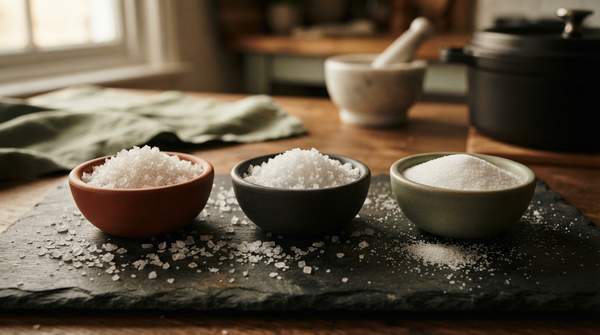
The right salt for a job comes down to three physical facts: how big the crystals are, how they dissolve, and what minerals ride along with them. A coarse kosher salt seasons a steak differently than a pink finishing salt dresses a salad—not because one is "better," but because crystal size, shape, and mineral content change how salt hits food, how fast it disappears into a batter, and how much of it clings to a surface. Once you understand those mechanics, you can pick the right salt for any task, from brining to finishing, without memorizing a single brand chart.
The Core Principles of Salt Selection
Start with crystal size, because it drives nearly everything else. Large crystals dissolve more slowly and sit visibly on the surface of food, which is exactly what you want when you crust a piece of meat or finish a dish at the table. Fine grains dissolve quickly and evenly, which matters most in baking, where an undissolved crystal means a pocket of harsh saltiness in an otherwise tender crumb. Culinary educator Sarah Larson, writing for Escoffier Online, notes that kosher salt's large crystals dissolve easily, yet she still advises home bakers to make sure it is fully dissolved before it goes into dough.
Shape and density also govern how salt behaves in the hand. A flaky, low-density crystal pours lightly and spreads across a surface, while a dense, fine grain delivers a concentrated hit of salinity in the same measured spoonful. This is why experienced cooks season by feel with coarse salts but weigh carefully with fine ones. Perceived saltiness follows the same logic: a crystal that lingers on the tongue's surface registers differently from one that vanishes instantly into a sauce.
Then there is the practical wrinkle every cook eventually hits: brands are not interchangeable. Larson flags that "saltiness" can vary by brand, so you need to understand a salt's salinity to measure accordingly. Two boxes labeled "kosher salt" can behave differently in the same recipe, which is why recipes that name a specific brand are doing you a favor. The principle to carry away is that a salt swap is really a density swap—and density is what your measuring spoon actually measures.
Finally, composition matters. Salts free of additives, or rich in trace minerals from their source, taste different to many cooks—not necessarily stronger, but different in character. Kosher salt's reputation for a "pure" or "clean" taste, as Larson describes it, is tied to its lack of anti-caking agents and its 97.5% salinity, a perceived quality rather than a lab-verified flavor intensity. Treat mineral-driven flavor notes as character, not potency, and you will season more accurately.