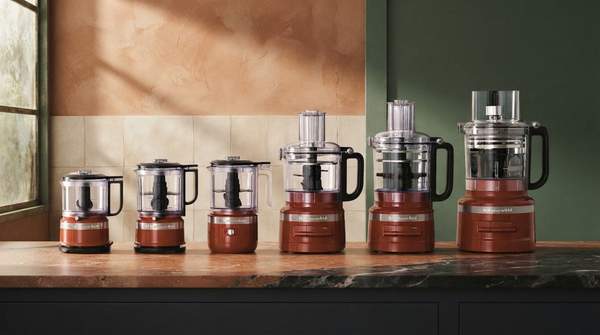
The right food processor category depends on two questions: how much food you typically prep at once, and how demanding your tasks are. Mini choppers handle small batches of herbs, nuts, and sauces; compact 7- to 9-cup models cover everyday chopping and slicing for small to medium meals; full-size machines of roughly 11 to 16 cups take on dough kneading and high-volume prep. This guide compares those categories—plus continuous feed designs for very high-volume cooks—so you can buy once, correctly. One note up front: immersion blender attachments are a distinct tool category and are not covered here.
Understanding Food Processor Categories
Food processors divide first by design. The familiar countertop machine is a batch bowl processor: a single motor base drives interchangeable blades and discs inside a large, removable bowl, and you process a fixed quantity, empty the bowl, and refill. Food service supplier WebstaurantStore describes batch bowl processors as "the versatile multitaskers of the kitchen," powered by one motor base running various attachments.
The second design is the continuous feed processor, which dispenses processed food directly into a separate container so you can keep feeding ingredients without stopping to empty a bowl. WebstaurantStore illustrates the difference with a kitchen that uses a blender to perfect a hollandaise but relies on a continuous feed processor to julienne a case of carrots uniformly. That scale hints at the trade-off: continuous feed machines are built for sustained, high-volume output and are far more common in commercial settings than home kitchens.
Mini Food Processors: Small Tasks, Big Convenience
Mini food processors and choppers are engineered for small-scale tasks, with capacities generally ranging from 1 to 5 cups—some mini choppers hold as little as 1 cup. Consumer Reports' lab-tested coverage, led by home and kitchen writer Althea Chang-Cook, makes the case plainly: most full-sized processors are too big for processing small volumes such as minced garlic or chopped herbs and nuts, and if you only chop small batches, a food chopper is all you need.
Where minis shine is convenience and footprint. They excel at chopping nuts and herbs, making small-batch sauces, and puréeing single servings, and they take up minimal counter and cabinet space. The boundary is equally clear: they are not suitable for large volumes or heavy-duty tasks like kneading dough. If your cooking revolves around garnishes, dressings, and quick aromatics rather than big prep sessions, a mini is the honest answer rather than a compromise.