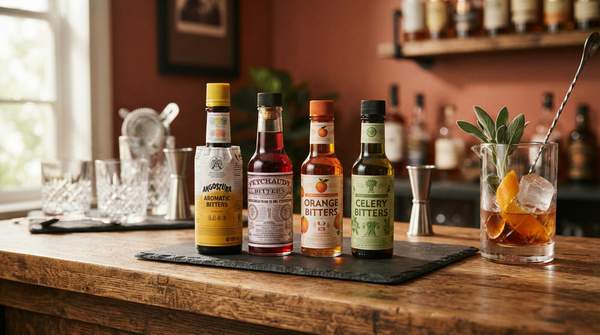
If you want to mix by-the-book Manhattans, Old Fashioneds, Sazeracs and Martinis, you need exactly four bottles of bitters: Angostura Aromatic, Peychaud's, Orange, and — once the classics are covered — Celery. Each one does a different job in the glass, and knowing which drink calls for which bottle is the single fastest way to level up your home bartending. This guide compares all four side by side, so you can match your shopping list to the drinks you actually want to pour.
Essential Bitters for Your Home Bar
Bitters are the salt of the cocktail world: a few dashes at a time, they sharpen, deepen and tie together everything else in the glass. They're concentrated botanical infusions, used in tiny quantities precisely because their flavor is intense. But not all bitters are interchangeable, and the first mistake most home bartenders make is treating them as one generic ingredient — grabbing whatever bottle is nearest and shaking it over everything.
The core trio is remarkably consistent across expert recommendations. Jerard Fagerberg's home bartender guide for InsideHook calls Angostura essential for several canonical drinks, and identifies Peychaud's as the must-have bottle for New Orleans' signature cocktails. Angostura itself, on its official site, describes its Original Aromatic Bitters as a "bouquet of fruits, spices and herbs" and its Orange Bitters as a "warming array of citrus and spiced notes" — producer language, to be sure, but useful for picturing what's in the bottle before you taste it.
What makes these three foundational rather than merely popular is that each anchors a distinct family of drinks. Angostura's spice-and-fruit depth belongs with aged spirits; Peychaud's mint-and-anise edge defines an entire city's cocktail heritage; orange bitters carry the bright, citrus-forward end of the repertoire. Skip one, and a whole shelf of classic recipes becomes impossible to make properly.
There's also history in these bottles, and it explains why they feel non-negotiable. Peychaud's, as Fagerberg notes, is a proprietary recipe that dates back to the 1800s, and it first made landfall in the United States through New Orleans — which is exactly where its signature drinks were born. Angostura, meanwhile, has been around long enough that its aromatic style has spawned imitators often marketed as "old-fashioned bitters" or "angobitters," all featuring hints of clove, cardamom, orange peel and gentian root. When a recipe says "bitters" with no qualifier, this aromatic style is almost always what it means.