The single question that decides your leavener is this: does your recipe contain an acidic ingredient? Baking soda is sodium bicarbonate, and it only produces the carbon dioxide that makes a batter rise when it meets an acid. Baking powder carries its own acid inside the can, so it works in batters that have none. Get this pairing right, and the rise, crumb, and even the flavor of your bake follow directly from the chemistry.
The Science of Leavening: How Baked Goods Rise
Leavening is, at its heart, gas management. A batter or dough rises because bubbles of carbon dioxide form inside it, become trapped, and then expand as the bake heats up and its structure sets. KitchenAid's guide to leavening agents describes the process plainly: when baking soda combines with an acid, carbon dioxide gas forms, "producing bubbles that make the dough or batter rise."
NC State's science desk calls this "chemical leavening," and points to the grade-school volcano—vinegar poured over baking soda—as the same reaction at work in your mixing bowl. The trapped CO₂ gas is what lifts the dough. What separates a good bake from a flat one is not just whether gas forms, but when it forms, how much of it the batter can hold, and whether the structure sets before the gas escapes. That timing is where the differences between leaveners really matter.
Baking Soda: The Acid-Dependent Leavener
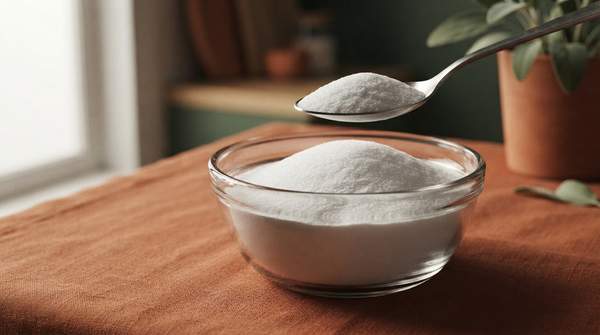
Baking soda goes by two other names—bicarbonate of soda and sodium bicarbonate—and on its own it is only half of a reaction. It needs a partner. When it comes into contact with an acidic ingredient, the two react and release carbon dioxide on the spot.
That immediacy is both its power and its pitfall. As NC State explains, when baking soda meets an acid, "it pretty much reacts immediately. And that's a problem." Many recipes benefit from an extended, staged release of gas rather than one burst at mixing, because a rise that happens all at once can fizzle before the batter ever reaches the oven. This is why recipes that call for baking soda—think buttermilk pancakes, yogurt cakes, or quick breads with lemon juice—also instruct you to mix quickly and get the batter into the oven without delay. The clock starts the moment the wet, acidic ingredients touch the soda.
Baking Powder: The Self-Contained Leavener
Baking powder solves the acid problem by bringing the acid with it. According to the baking industry reference BAKERpedia, written by Joanna Evoniuk, baking powder is a leavening agent that contains "a combination of bicarbonate, acid and a filler such as cornstarch." It is a complete system: the base and the acid are both in the box, held apart by the filler.
That filler is not inert padding. A product description from Essential Organic Ingredients explains that the starch component—cornstarch in many formulations, potato starch in theirs—absorbs moisture and keeps the alkaline and acidic components dry, preventing them from reacting with each other prematurely on the shelf. Because the powder contains its own acid, it needs nothing from your recipe except liquid to work, which is why it suits batters built on non-acidic ingredients like plain milk. The same source notes that baking powder itself is near pH neutral, unlike baking soda, which is alkaline.
Single-Acting vs. Double-Acting Baking Powder: Timing is Everything
Not all baking powder releases its gas on the same schedule, and the difference is the most useful piece of leavening science a home baker can own. KitchenAid draws the line clearly: single-acting baking powder reacts when hydrated and does not need heat to react. Double-acting baking powder reacts when hydrated, and reacts again when heat is introduced.
BAKERpedia describes the two stages in practice: the first gassing typically takes place during mixing, when the batter is hydrated, and the second happens during baking, when the batter is heated. This is why double-acting powder is forgiving. Your first burst of gas gets you to the pan; the second, heat-triggered burst gives you oven spring. Retail baking powders sold for home baking are usually double-acting, so the can in your cupboard almost certainly behaves this way.
The mechanism behind the two stages comes from using different acids that trigger under different conditions. NC State notes that double-acting powder "has different ingredients that create CO₂ gas at different stages of the baking process." A commercial ingredient listing shows what those components look like in a real product: monocalcium phosphate among the fast-acting, moisture-triggered acids, and sodium acid pyrophosphate among the slow-acting, heat-triggered ones, alongside sodium bicarbonate and starch.
The payoff is measurable. A peer-reviewed study on pound cake, published in the research literature on batter and cake properties, found that cake specific volume and porosity were influenced by the amount of expanded CO₂ gas bubbles the batter could contain during baking as the structure sets—meaning the gas released by heat, at the moment starch gelatinization and protein denaturation are locking in the crumb, is what ultimately determines how tall and how open your cake is.
Decision Framework: Choosing Your Chemical Leavener
Here is the diagnostic process. Read your ingredient list first, and ask one question: is there a significant acid present—buttermilk, yogurt, lemon juice, vinegar, or similar? The answer routes you to the correct leavener.
| What's in your recipe? | Diagnosis | Recommended leavener | Why it works |
|---|---|---|---|
| Acidic liquid present (buttermilk, yogurt, lemon juice, vinegar) | Acid is available to react | Baking soda | Sodium bicarbonate reacts with the acid to release CO₂ immediately |
| No significant acid (plain milk, water, mostly neutral ingredients) | No acid available to react with soda | Baking powder | Contains its own bicarbonate plus acid, so it needs no added acid |
| Acid present, but recipe calls for both soda and powder | More acid than the soda alone can neutralize, or a staged rise is wanted | Both | Soda reacts with the acid immediately; powder adds a second, heat-triggered release |
Two practical notes complete the framework. First, timing: because baking soda and single-acting powder begin releasing gas the moment they are hydrated, batters leavened with them should reach the oven promptly—the rapid reaction causes problems if it is delayed. Second, most home baking powders are double-acting, so you get a built-in second chance: some gas at mixing, and more when the heat arrives.
Mastering Your Rise: Key Takeaways for Better Baking
Always consider the acidity of your recipe's ingredients before choosing a leavening agent. Scan the wet ingredients for buttermilk, yogurt, or citrus juice; if they are there, baking soda has its partner, and if they are not, baking powder brings its own. Remember that the reaction starts at mixing for soda and single-acting powder, while double-acting powder saves half its lift for the oven, where the setting structure can capture it.
The measure of success is a consistently well-risen baked good with the desired texture, indicating correct leavener selection. When your next cake or quick bread comes out of the oven, check that indicator: an even rise, an open crumb, and no dense, gummy center tell you the acid-to-leavener pairing was right. If the rise falls short, the first variable to revisit is whether your recipe's acidity matched the leavener you reached for.
Sources
- Four types of bread leavening agents — Kitchenaid
- The Difference Between Baking Soda and Baking Powder — NC State News
- Double-Acting Baking Powder | Baking Ingredients — BAKERpedia
- BAKING POWDER, double acting, Alu & GMO free — Essential Organic Ingredients
- Impact of Baking Powder and Leavening Acids on Batter and Pound Cake Properties - PMC