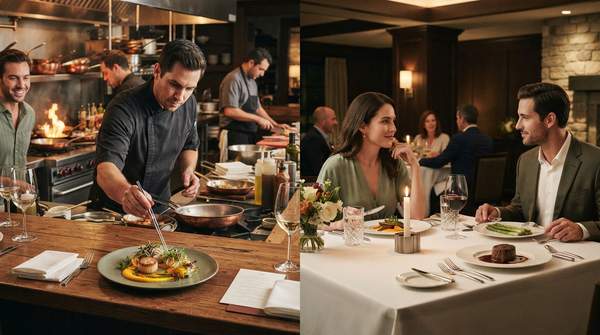
The choice between a chef's table and a standard fine dining room comes down to one question: do you want to be close to the cooking, or cocooned from it? A chef's table puts you inside or beside the kitchen — a small, exclusive seat where a chef or sous-chef personally guides you through a set tasting menu, and where the noise, heat and rhythm of service become part of the meal. Standard fine dining keeps you in a refined dining room with structured service, fuller menu choice and greater privacy. Here is how the two compare, what to expect at each, and how to decide which suits your occasion, budget and group.
Introduction: Choosing Your Culinary Journey
Both formats promise exceptional food, but they sell fundamentally different evenings. Fine dining, as one comparison puts it, is "usually in a refined, often grand setting, with a focus on elegance and formality." A chef's table is the opposite trade: intimacy over elegance, immersion over distance, and a menu chosen for you rather than by you.
Part of what you pay for at a chef's table is scarcity. Restaurant-industry writing describes it as "the most exclusive seat in the building," typically limited to a handful of guests per service and requiring advance arrangement. One hospitality analysis frames the concept around three levers — scarcity, proximity and spectacle — noting that "the kitchen is no longer a sealed black box but a stage." The dining room, by contrast, trades none of its privacy for that access. Knowing which currency you are buying — access or seclusion — is the first step in the decision.
The Chef's Table: An Immersive Culinary Spectacle
In its traditional form, a chef's table is exactly what the name implies: a table inside or immediately adjacent to the kitchen, historically reserved for VIPs, food critics or particularly loyal returning guests. The kitchen team serves it personally, and it often features dishes that are not on the standard menu at all. The experience is centred on the craft of cooking as much as on the food itself, with direct visibility into the process and, in most cases, direct interaction with the chef or senior kitchen staff.
That proximity is not passive. Guests at the pass hear the clanking of the service station, the chef's calls, and the controlled urgency of a service in full flow — one account argues this ambience "contextualises the food in a way that cannot be replicated anywhere else in the building." It is worth distinguishing the in-kitchen table from the purpose-built counter restaurant: the counter is designed as a primary mode of dining for solo guests, pairs and small groups, while the in-kitchen chef's table functions as a special-occasion upgrade. They suit different evenings, and restaurants increasingly offer both.