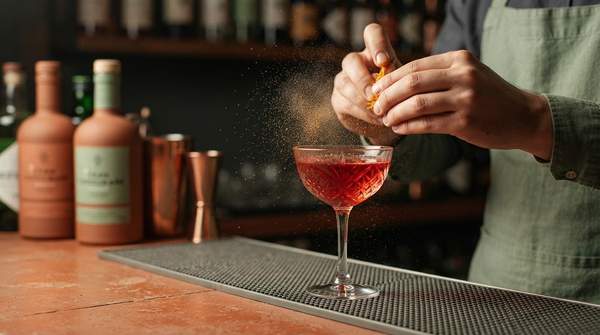
Every great cocktail is, in part, a glass of carefully measured water. When you shake or stir a drink with ice, the heat from the liquor melts part of that ice, and the meltwater becomes an ingredient in its own right—one that softens harsh alcohol heat and pulls the components into balance. The choice between shaking and stirring is really a choice about how much water enters the drink, how cold it gets, and what texture it carries to your lips.
As Paul Adams put it when writing about cocktail chilling for America's Test Kitchen, "the purpose of shaking or stirring a cocktail is all about causing ice to melt." Master that single idea, and the rest of the technique falls into place.
Shaking vs. Stirring: The Core Differences
The two methods chill and dilute through the same physics—heat transfer from the warmer liquid to the colder ice—but they do it at very different speeds and with very different side effects. Shaking is a violent activity: the ice fragments, tumbles and crashes through the liquid, maximizing contact and melting. Stirring is gentle by comparison, with ice gliding in a smooth circle and transferring heat far more slowly.
That difference in violence matters beyond speed. Shaking forces tiny air bubbles into the liquid, increasing aeration and changing both texture and the way certain spirits express themselves—gin's botanicals, for instance, can read differently in an aerated drink. Stirring, by contrast, retains the spirit's natural character and produces a smooth, silky mouthfeel without aeration, as the European Bartender School explains in its technique guide.
Shaking: Rapid Equilibrium and Aeration
The most useful thing to know about shaking is that it is forgiving. Dave Arnold's experimental work on cocktail science, published on Cooking Issues, found that shaking completely chills, dilutes and aerates a drink in around 15 seconds, after which the drink stops changing radically and reaches relative equilibrium. If you shake for roughly 12 to 15 seconds—and you aren't too lethargic about it—neither the type of ice you use nor your personal shaking style will appreciably affect the temperature or dilution of your drink. Shaking longer won't hurt, but it also won't help much.
This insensitivity to bartender-induced variables is the shaking method's greatest strength. Once a drink hits equilibrium, it is essentially done: maximally cold, fully diluted, and aerated with a frothy cap of tiny bubbles. That frothiness is exactly what you want in drinks containing citrus juice, cream or egg, where the aeration helps integrate heavy, opaque ingredients into a unified texture. The trade-off is clarity—shaken drinks emerge cloudy, and the tiny air bubbles that lighten the mouthfeel also scatter light. For a Daiquiri, that cloudiness is a feature. For a crystal-clear Martini, it would be a flaw.
Stirring: Controlled Dilution and Clarity
Arnold's blunt framing for stirring is that it is simply "inefficient shaking." It can take over two minutes of constant stirring to accomplish what shaking manages in fifteen seconds—and since no one stirs a drink for two minutes, a stirred drink never actually reaches an equilibrium point. The drink stops when the bartender decides it stops.
That sounds like a weakness, but it is also stirring's defining advantage: control. Because the process is slower and more variable, the bartender—not the physics—determines the final temperature and dilution. Stir a Manhattan or Negroni for a shorter time and it stays stronger and warmer; stir longer and it approaches the chill and water content of a shaken drink. Stirring also preserves clarity, which is why spirit-only drinks where visual appeal and a pristine, silky texture matter are stirred rather than shaken. As a general guideline from Cocktails & Bars, stirred and spirit-forward drinks may receive between 40 and 45 percent dilution, though this figure is bartender-controlled rather than physics-imposed.
Shaking vs. Stirring: A Cocktail Decision Framework
Use the matrix below to categorize any drink by its ingredients and your desired outcome, then read across to see what each technique delivers. The framework maps ingredients to technique by evaluating each method's impact on texture, aeration, clarity and dilution.
| Dimension | Shaking | Stirring |
|---|---|---|
| Best for | Citrus juices, cream, egg — drinks that need integration | Spirit-only drinks where the liquor's texture is key |
| Speed to equilibrium | Reaches maximum chill and dilution in about 15 seconds; after that it will not get significantly colder or more diluted | Would need over 2 minutes of constant stirring to match; rarely reaches equilibrium, so the bartender controls the endpoint |
| Texture | Aerated and frothy; tiny air bubbles lighten the mouthfeel | Smooth and silky, with no aeration |
| Clarity | Cloudy from aeration — acceptable or desired for juice-based drinks | Clear, preserving visual appeal |
| Typical dilution | Around 30 percent as a general guideline | 40–45 percent as a general guideline, with more room for bartender control |
The logic behind the matrix is straightforward. Ingredients with body—citrus, cream, egg—benefit from violent mixing and aeration to blend into one texture, and their drinks are naturally opaque anyway, so shaking costs nothing visually. Ingredients that are all spirit, by contrast, are already homogeneous; they need chilling and dilution only, and shaking would sacrifice clarity and add an unwelcome froth to what should be a sleek, silky drink.
One practical note on scope: this framework applies to standard ice cubes. Advanced techniques like "throwing," and the specific behavior of large-format ice such as spheres and spears, follow different rules and are outside this comparison. Carbonated drinks are also a separate case, since sparkling ingredients add their own dilution.
Mastering Dilution for Balanced Cocktails
The practical decision is this: intentionally choose between shaking and stirring based on your cocktail's ingredients and your desired outcome for texture, clarity and dilution. If the drink contains citrus, cream or egg, shake it hard for about 15 seconds and let equilibrium do the work—your technique and ice shape won't appreciably change the result. If the drink is spirits-only and you want it clear, silky and precisely diluted, stir it, and recognize that you, not the physics, are deciding when it is finished.
The measurable indicator of success is the drink in the glass: the final cocktail should consistently exhibit your desired temperature, texture—frothy for a shaken Daiquiri, silky for a stirred Manhattan—and flavor balance, indicating appropriate dilution. Taste a drink right after preparing it and note whether the spirit heat is softened and the flavors integrated; if the drink tastes hot and disjointed, it needed more meltwater, and if it tastes washed out, it got too much. That single observation, repeated across drinks, is how dilution stops being an accident and starts being a tool.
Sources
- Shaken vs. Stirred: Why Does It Matter How You Chill a Cocktail? Ask Paul — America's Test Kitchen
- Shaking vs stirring a cocktail: which technique should you use? — European Bartender School
- Cocktail Science in General: Part 1 of 2 – Cooking Issues — Cookingissues
- How to Calculate Dilution for Pre-Batched Cocktails - Cocktails & Bars