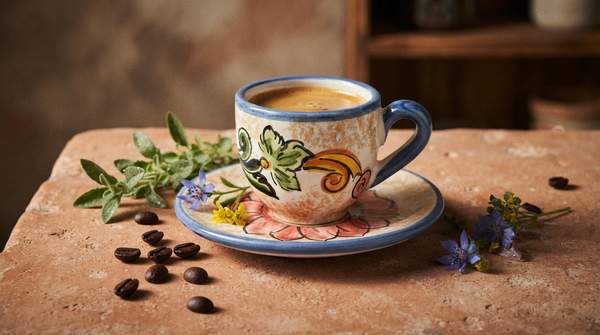
Italy's coffee culture is not one culture but many, and the fastest way to appreciate it is to stop thinking of "an Italian coffee" and start thinking in regions. In Turin, you order a Bicerin, a layered glass of espresso, drinking chocolate, and whipped cream. In Padua, you ask for a coffee in the patavina style, finished with mint syrup and cocoa. Order a Caffè Corretto in the north and you will likely be offered grappa; in the south, sambuca is the more common "correction." This guide walks through the specialties, the regional logic behind them, and the etiquette that holds the whole ritual together.
Regional Coffee Specialties Across Italy
What makes regional Italian coffee fascinating is how the same national ingredient — espresso — gets reinterpreted city by city. Turin's Bicerin, documented since at least the early 19th century according to Lavazza's guide to Italian coffee culture, is served in a small glass where espresso, drinking chocolate, and whipped cream sit as three visually distinct layers. The drink has aristocratic literary credentials: Alexandre Dumas and Friedrich Nietzsche reportedly frequented the Caffè Al Bicerin near the Santuario della Consolata, where it has been served since 1763.
Here the sources disagree, and it is worth knowing before you lift a spoon. ItaliaRail's regional coffee guide describes stirring as the local tradition: "pop in your spoon — it's local tradition to stir ingredients together and savor the aromas before drinking." Lavazza, by contrast, states the layers are "traditionally not stirred before drinking." Rather than a contradiction to resolve, treat it as a live local debate — and watch what the person next to you at the bar does.
Padua offers something cooler and more unusual. The patavina tradition, which ItaliaRail traces to a 19th-century habit of intellectuals and politicians, combines espresso with cream, a dash of mint syrup, and a dusting of cocoa. It is a drink that announces itself as northern: layered, aromatic, and closer to a dessert than a jolt of caffeine.
The Caffè Corretto shows how one drink splits along regional lines. Lavazza describes it as a standard espresso of roughly 30–40 ml "corrected" with a small measure of spirits — small enough to add warmth and depth rather than to dominate. Grappa is the most traditional accompaniment in northern and central Italy, while sambuca is more common in the south, with brandy as another option. The drink has working-class roots: it was historically consumed in the morning by laborers as an early start to the day, though today it is more commonly enjoyed after lunch or dinner.
Travel writing collected by Luggage and Life adds further regional color. Milan has the Barbajada, served hot or cold with whipped milk or cream — essentially what is known elsewhere as a mocha. In Puglia, a hot summer day calls for a Caffè Leccese, coffee sweetened with cold almond milk and served on ice, while the espressino the site's author encountered on Puglian bar menus turned out to be a regional name for a marrocchino, espresso with milk and chocolate.
Then there is Trieste, which operates almost as a coffee nation of its own. A Fandango Tour guide to the city admits the local lexicon is "difficult even for an Italian," with variations that might push "even the most navigated of the barista" toward a nervous breakdown. Two customs stand out. At the counter, next to the sugar bowl, you always find a miniature milk jug, so you can freely pour a few drops of cold milk into your espresso — something the guide notes experienced travelers may have seen in other northern cities too. And do not be fazed if a local impassively orders a "gocciato": that is a coffee with only a few drops of foamy milk, poured right at the center of the cup.
Regional Italian Coffee Specialties at a Glance
The table below gathers the specialties described above so you can identify them quickly on a menu. Use it as a field guide: match the drink name to the region you are in, check the composition, and note the serving context before ordering.
| Drink | Region / City | Composition | Serving Style / Context |
|---|---|---|---|
| Bicerin | Turin, Piedmont | Espresso, drinking chocolate, and whipped cream, layered in a glass (100–150 ml) | Morning or mid-morning; a cold-weather ritual. Sources conflict on stirring: one says stirring is local tradition, another says the layers are traditionally left unstirred |
| Patavina-style coffee | Padua, Veneto | Espresso with cream, a dash of mint syrup, and a dusting of cocoa | A 19th-century tradition originally among intellectuals and politicians |
| Caffè Corretto (northern style) | Northern and central Italy | Espresso (30–40 ml) with a small measure of spirits, most traditionally grappa | After meals today; historically a morning drink of laborers |
| Caffè Corretto (southern style) | Southern Italy | Espresso with a small measure of spirits, more commonly sambuca, or brandy | After meals today; occasionally morning in regional tradition |
| Barbajada | Milan, Lombardy | Coffee with chocolate — what is known elsewhere as a mocha | Served hot or cold, with whipped milk or cream |
| Caffè Leccese | Puglia (Apulia) | Coffee sweetened with cold almond milk | Served on ice; a hot-summer-day drink |
| Espressino | Puglia (Apulia) | Espresso with milk and chocolate — a regional name for a marrocchino | Found on local bar menus |
| Gocciato and self-service milk | Trieste | Espresso with only a few drops of foamy milk poured at the center of the cup; cold milk freely available from a jug at the counter | Counter service; part of Trieste's distinctive ordering lexicon |
Navigating Italy's Diverse Coffee Scene
Underneath the regional variety sits a shared etiquette that Lavazza describes as rarely posted, never enforced by signs, and "immediately apparent to anyone who observes locals for more than five minutes." The most famous rule is also the least understood by visitors: cappuccino, caffè latte, and latte macchiato are breakfast drinks, and the window closes around 11 a.m. in most of Italy. Order one after that and you are marking yourself as an outsider — nothing catastrophic, but noticeable.
The regional pattern worth internalizing is the north–south split you can taste in the Corretto: the north leans toward grappa, the south toward sambuca. Trieste's counter culture — the communal milk jug, the precise vocabulary of the gocciato — shows how far a single northern city can push coffee into its own dialect. Meanwhile the south answers with iced, almond-milk-sweetened Caffè Leccese and the espressino. None of these is "more authentic" than the others; they are parallel traditions growing from the same root.
A few honest limits to this guide. It is built on travel and culinary reporting, not original anthropological research, and the drinks here are illustrative rather than exhaustive — Italy produces far more regional specialties than any single article can catalog. It is also not a glossary of standard drinks like the macchiato or ristretto; for those, a general Italian coffee guide will serve you better.
Embrace Italy's Coffee Diversity
The decision this guide supports is simple: treat coffee as a regional dish, not a commodity. Before each trip segment, pick one specialty from the table above — a Bicerin in Turin, a patavina-style coffee in Padua, a sambuca-corrected espresso in the south — and order it deliberately, at the appropriate time of day, watching how locals handle the ritual (including whether they stir). The measurable indicator of success is straightforward: successfully ordering a regional specialty by name and feeling confident, rather than lost, when participating in local coffee rituals — from the 11 a.m. milky-coffee cutoff to Trieste's self-service milk jug at the counter. Do that in three different regions and you will have tasted, in miniature, the real map of Italy.
Sources
- Italian Coffee Culture: Drinks, History & Etiquette — Lavazzausa
- Exploring Italian coffee culture — ItaliaRail
- Coffee culture 101: Trieste — Fandangotour