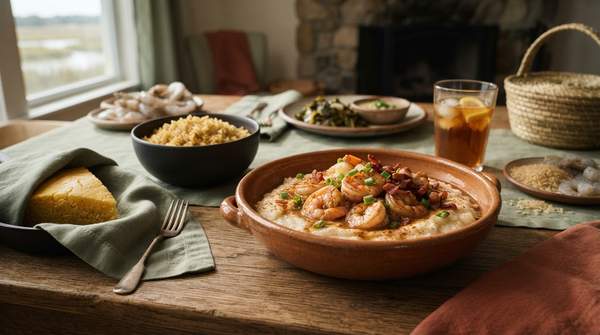
Lowcountry cuisine is the traditional cooking of the South Carolina and Georgia coasts—a flat, marshy strip running roughly from Charleston down through Savannah—and what sets it apart from general Southern food is a specific combination of geography and history. The pantry comes straight from the land and water: rice, shrimp, crab, oysters, okra, corn, and pork. The techniques and soul of the cooking come largely from the Gullah Geechee people, descendants of enslaved West Africans whose rice knowledge and one-pot cooking traditions shaped nearly everything distinctive about the region's plate.
Introduction: What Is Lowcountry Cuisine?
Ask a local what separates Lowcountry food from Southern food in general, and the short answer is geography. The Lowcountry is the low-lying coastal region where tidal rivers and salt marshes shaped both what could be grown and what could be caught. Rice, shrimp, crab, oysters, okra, corn, and pork form the core pantry; everything else, as one local guide puts it, is "technique and time."
While the cuisine shares features with broader Southern cooking, it incorporates a distinctive diversity of local seafood, produce, and native spices, along a coast where African, Caribbean, and European influences converged. The distinction is one of concentration: these particular influences and ingredients cluster densely in this defined coastal region rather than differing universally across all Southern food. Understanding that concentration is the key to recognizing the cuisine when you travel—or to cooking it at home.
The Gullah Geechee Legacy: A Culinary Foundation
The deeper answer to "where does this cooking come from" lies with the people who built it. Enslaved West Africans brought rice cultivation knowledge to the coastal plantations, and that expertise made Carolina Gold rice one of the most valuable crops in early America. Their descendants, the Gullah Geechee, kept the cooking alive through one-pot rice dishes, okra soups, benne seeds, slow-simmered greens, and seafood stews built from whatever the tide gave up.
Reporting from ABC News on the cuisine's history emphasizes that its foodways draw on both ingredients that arrived from Africa during the slave trade and ingredients indigenous to the Americas—a creolized tradition rather than a transplant. Later influences layered on top: French technique from Huguenot settlers, Caribbean spice from the shipping trade, and inland farmhouse cooking. But the foundation remained Gullah Geechee. Chef Nigel Drayton, speaking about his Gullah Geechee roots, described how the cuisine grew from making meals for families "using what we had"—including shrimp, which he recalled was once considered a trash food before his community transformed it into a delicacy.