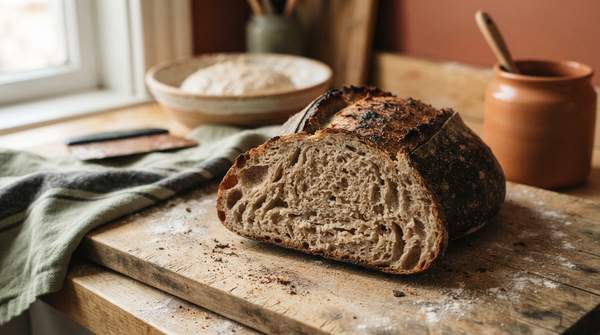
When a loaf comes out dense, gummy, or deflated, the problem almost always traces back to one of three controllable factors: the flour you chose, the water you added, or the work you did to the dough. Gluten—the elastic protein network that forms when wheat flour meets water and mechanical force—determines whether bread traps gas and rises or collapses under its own weight. This guide explains the science and then walks you backward from the specific failure you're looking at to the variable that most likely caused it.
The scope here is deliberately narrow: this covers yeast-leavened breads made from wheat flour. Gluten-free baking and chemically leavened breads follow different rules. And the troubleshooting framework below addresses the most common failures, not every possible baking mishap.
Understanding Gluten: The Foundation of Bread Texture
Gluten is the protein network that gives bread its structure, and it's the reason wheat flour behaves so differently from other grains. When flour and water combine, two families of proteins—gliadin and glutenin—hydrate and begin bonding into long, elastic strands. As Scott Groves explains in his breakdown of gluten science for CKitchen, this network acts as "the internal scaffolding that gives bread its chew and ability to hold shape."
The network does three jobs in sequence. First, it captures the carbon dioxide that yeast produces during fermentation, creating rise. Second, it stretches to accommodate that gas without rupturing. Third, heat during baking permanently sets the structure, locking in the final texture. If the network is underdeveloped, gas escapes. If it's overworked or exhausted, it tears or collapses. The same network also explains why bakers deliberately limit gluten in other contexts: as Modernist Cuisine's culinary team notes, low-gluten flour is used for cake precisely because a strong gluten network would make the texture rubbery.
The Three Levers of Gluten Development
Every bread texture outcome comes down to three levers, and understanding them lets you cook from observation rather than recipe-dependence. The first is flour selection, because the protein content of the flour sets the ceiling on how much gluten can possibly form. The second is hydration, because the proteins cannot bond until water lets them move. The third is mechanical action and time—kneading, folding, and resting—which does the work of actually connecting those hydrated proteins into a network.
Culinary scientist Ali Bouzari, speaking with Epicurious, offers a perspective that reframes how most home bakers think about timing: "As soon as you've gone from dry flour to a wet mass, the clock starts ticking." Gluten development doesn't begin when you start kneading. It begins the moment water touches flour, which is why rest periods like the autolyse—an intentional pause after mixing flour and water before kneading—contribute to development without any kneading at all.
Flour Power: Protein Content and Its Impact
Protein content is the raw material for gluten, and the differences between common flours are substantial. Bob's Red Mill lists its unbleached white all-purpose flour at 10 to 12 percent protein, its whole wheat flour at 13 to 15 percent, and its artisan bread flour at 12.5 to 13.5 percent. King Arthur Baking, which guarantees the protein percentage printed on its bags, specifies its all-purpose flour at 11.7 percent and its bread flour at 12.7 percent. These are brand-specific figures, and protein percentages do vary between brands—which is one reason the same recipe can behave differently with different flours.
Higher protein means more gluten-forming potential, which suits chewy, open-crusted yeast breads. Lower protein flours yield more tender results. Whole wheat presents a complication that Modernist Cuisine highlights: whole-grain flours contain plenty of protein, but the bran and germ interfere with gluten development. The thirsty bran particles prevent proteins from fully hydrating, release compounds that weaken gluten, and can create microscopic holes in the gas-trapping walls of the dough. Similarly, semolina and most ancient grains lack good gluten-forming properties, which is why they are often blended with other wheat flours in bread recipes.
The Role of Water: Hydration for Elasticity
Hydration is the activation step for gluten development. As Groves describes it, water dissolves starch and hydrates the gliadin and glutenin proteins, allowing them to move and bond—which is why dough hydration is the first crucial step in the process. No amount of kneading can develop gluten in a dough that lacks the water for proteins to link up.
Hydration levels also shape the crumb structure directly. According to Groves, higher hydration produces a more open crumb, while lower hydration produces a tighter one. When hydration is insufficient, the dough becomes stiff and difficult to work with, lacking pliability, and the finished bread turns out dense and dry. The degree of that dryness and density corresponds to the extent of the hydration shortfall. This is why dough feel matters more than blindly following a recipe's liquid measurement: flours absorb water differently, and the dough in front of you is the real evidence.
Mechanical Action: Kneading, Folding, and Time
Mechanical force is what transforms hydrated proteins into a connected network. Kneading aligns and links the proteins into the long strands that give dough its elasticity. The development continues with time, too: rest periods like the autolyse improve dough handling and extensibility without additional kneading, as the baking educators at Sour Flour note.
But more is not always better. Dough can be underdeveloped—dense, flat, tearing easily, with poor rise—or overdeveloped, becoming tight, tough, difficult to shape, and resistant to stretching, per Groves. Over-kneading, particularly with mechanical mixers, can tear the gluten network. And time works against gluten as well: Epicurious cites Bouzari's explanation that a naturally occurring enzyme in dough, protease, breaks down gluten over time. That's the mechanism behind the heartbreak of a dough that proofed too long and "deflated like a sad balloon" when transferred to the pot. Proper gluten development shows itself in dough that is elastic and smooth, holds its shape, and stretches without tearing.
Diagnosing Bread Texture Problems: A Troubleshooting Guide
Here is the diagnostic payoff. Match the problem you observed in your finished loaf to its most likely gluten-related cause, then adjust that specific variable on the next bake. The reasoning path runs from evidence about how gluten forms and fails to the observed outcome.
Troubleshooting Your Bread: A Gluten Development Diagnostic
| Observed Texture Problem | Likely Cause in Gluten Development | Recommended Adjustment |
|---|---|---|
| Dense loaf with poor volume | Under-kneading: the gluten network never formed enough to trap gas; dough remained inelastic and tore easily | Knead until the dough is smooth and elastic, checking that it stretches without tearing |
| Gummy texture | Over-kneading—especially with a mechanical mixer—which tears the developed gluten network | Monitor the dough closely and stop once optimal elasticity is reached; watch machine-kneaded dough more carefully than hand-kneaded |
| Tough, tight dough that resists stretching | Overdeveloped gluten from excessive mechanical work | Reduce mixing or kneading time; use rest periods such as autolyse to build extensibility without added work |
| Dense, dry crumb with stiff, hard-to-handle dough | Insufficient hydration: without water, the gliadin and glutenin proteins cannot move and bond | Add hydration appropriate to the flour type and desired style; expect higher hydration for a more open crumb |
| Collapsed loaf with dough that deflates when handled | Over-proofing: the protease enzyme has broken down gluten, weakening the network so it can no longer support fermentation gas once the dough has expanded beyond its structural capacity | Bake before the dough doubles past its structural limit; watch the clock during proofing and handle ripe dough gently |
| Weak rise with whole-grain or blended-flour dough | Bran and germ physically and chemically interfere with gluten: thirsty particles block hydration and weaken the network, sometimes creating microscopic holes | Blend whole-grain flours with higher-gluten wheat flour, and compensate with adequate hydration |
Two caveats keep this tool honest. These are the most probable causes, not the only possible ones—flour brand variation, for instance, can shift protein content enough to change how a recipe behaves. And problems can compound: a marginally under-hydrated whole wheat dough that is also under-kneaded will fail more dramatically than either error alone.
Achieving Your Desired Crumb: Adjusting for Success
To consistently achieve desired bread textures, bakers should actively monitor and adjust flour choice, hydration levels, and kneading techniques based on observed dough characteristics and final bread outcomes. The diagnostic above turns each failed loaf into information: once you know a gummy crumb points to a torn network, you know the fix is watching the mixer, not changing the flour.
The measurable indicator that your adjustments worked is straightforward: the next loaf of bread exhibits the desired crumb structure, volume, and elasticity, indicating successful gluten development. Judge the dough before baking—it should be elastic, smooth, hold its shape, and stretch without tearing—and judge the crumb after. A dense loaf that becomes open, a gummy crumb that becomes even and structured, or a collapsing dough that holds its shape through the transfer to the oven each confirm that you correctly identified the failing lever and adjusted the right variable.
Sources
- Gluten Development Explained: How Hydration, Mixing & Kneading Shape Dough | Blog — CKitchen
- Gluten: How Does It Work? - Modernist Cuisine
- Knead, Rest, Repeat: How Gluten Actually Works — Epicurious
- Support
- Protein percentage in flour: Why it matters — King Arthur Baking
- Mastering the Art of Gluten Development: Unlocking the Secrets to Perfect Bread - Sour Flour