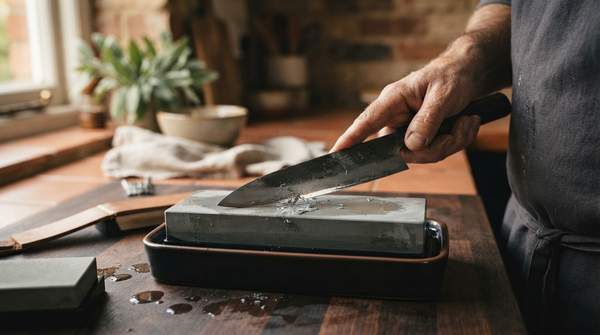
Sharpening a kitchen knife is not a vague ritual of scraping steel against stone. As knifemaker Keith Nix explains it, there is only one way to sharpen a blade: the two bevels of the blade must be ground so that they come together and create an apex — a fine, straight line with as small an edge width as possible and no burrs. Once you understand that sharpening means deliberately forming a new point where the blade's two sides meet, every sharpening method makes sense, and you can also see why some knives belong in your hands and others belong with a professional.
The Core Principle: What it Means to Sharpen a Knife
A knife's edge is, in cross-section, a wedge. The two flat sides of the blade angle toward each other, and where they meet is the apex — the actual cutting line. When a knife is dull, that meeting point has worn away or rounded off, so the wedge no longer converges cleanly. No amount of pressure in your cut can compensate for geometry that simply isn't there anymore.
Sharpening, in Nix's technical description, is the process of grinding the bevels — the angled faces of the blade — with stones or sandpaper so that they are brought together to create that apex. The tools vary widely; what does not vary is the goal. He notes that the scale involved is astonishingly small, measuring in microns — approximately forty-millionths of an inch — which is why the process demands high precision even though the concept is simple.
This is why sharpening removes material. You are not cleaning the edge or polishing it; you are removing enough steel from both bevels that they intersect again at a fresh, fine line. A dull edge is rounded where a sharp edge is pointed, and the entire craft of sharpening is the controlled removal of metal until the point is restored.
Visualizing the Sharp Edge: Apex Formation
To see what you are actually trying to achieve, picture the blade in cross-section as it moves through three states. This mental model, built from the knifemaker's definition, is the diagnostic framework that separates a dull knife from a sharp one — and it tells you what any sharpening tool, from whetstone to fixed-angle system, is doing when it contacts the steel.
| Stage | Cross-section shape | What it means for cutting |
|---|---|---|
| Dull edge (rounded apex) | The two bevels no longer meet at a point; the intersection is worn round | The blade crushes and tears rather than slicing cleanly |
| Grinding the bevels | An abrasive removes steel from both angled faces of the blade | The transitional step: the bevels are being reshaped toward each other |
| New sharp edge (fine apex) | The bevels meet in a fine, straight line with minimal edge width and no burrs | The blade cuts where it touches, with the precision the geometry allows |
The diagnostic value of this model is straightforward: if your knife is tearing a tomato skin instead of entering it, the apex is rounded. If your sharpening effort is not producing a new intersection of the bevels, it is not sharpening — it is just activity. The goal is always the same fine line, however you get there.