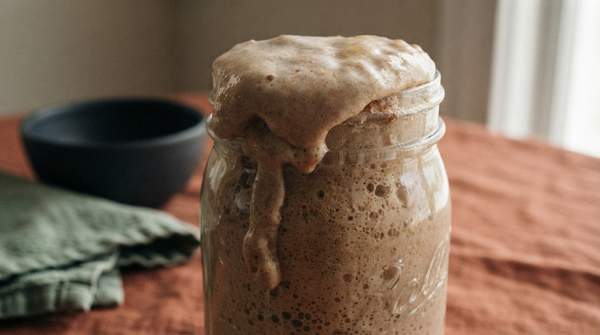
Hydration is the single most controllable variable in sourdough baking, and it starts before you ever mix your dough—with your starter. A starter fed equal parts flour and water by weight sits at 100% hydration, the "regular" style most bakers keep on the counter. Feed it far more water and it becomes a liquid starter; feed it less water and it becomes a stiff one. That one change in water content alters how fast the yeast works, how the dough handles, and how sour or mild your bread tastes. Here is how the science works, and how to use it.
Understanding Sourdough Starter Hydration Levels
Hydration is simply the weight of water expressed as a percentage of the weight of flour. A starter at 100% hydration means equal parts flour and water by weight, as Hendrik Kleinwächter of The Bread Code explains. A liquid starter, in his formulation, is dramatically wetter—he describes it at 500% hydration, five times as much water as flour. At the other end, a stiff starter runs around 50–60% hydration, using noticeably less water than flour. The flour and water in your starter also count toward your final dough's total hydration, so the starter's consistency carries straight through into the bread you eventually shape.
Why does water matter so much? Water is what wakes flour up. When flour is hydrated, its proteins—gliadin and glutenin—link into the gluten network that gives bread its structure and its ability to hold gas. Water also activates the flour's enzymes, which begin breaking down starches and proteins into food that yeast and bacteria can consume. In a sense, hydration is the on-switch for everything that follows: no water, no gluten, no fermentation. The amount of water you provide determines how easily those processes unfold and which microbes thrive.
Hydration also predicts how a dough will feel before you even mix it. Martin Philip of King Arthur Baking offers a useful rule of thumb: a recipe hydrated in the 75% to 85% range will likely be slack or sticky, while one in the 55% to 65% range will likely feel firm or even stiff. That expectation-setting is valuable, because it lets you diagnose a dough the moment it comes together rather than wondering halfway through bulk fermentation whether something went wrong.
Liquid, Regular, and Stiff Starters: A Comparative Guide
The three starter styles are not interchangeable, and the differences are measurable. Kleinwächter ran a simple comparative test: he built liquid, regular, and stiff starters from the same source culture, then measured how much each inflated a balloon. The stiff starter at 50% hydration inflated the most, the 100% hydration starter came second, and the liquid starter lost to both. His conclusion after the experiment was to switch to a stiff starter for his own bread, noting that it even performed well with cheap, low-gluten flour.
Flavor diverges too. Kleinwächter describes the flavor a liquid starter contributes to dough as "mild and dairy"—a profile he genuinely likes, even while acknowledging its yeast is less active. Stiff starters lean the opposite direction. A scientific explanation of microbial adaptation in low-hydration environments holds that reduced water creates osmotic stress that favors particular lactic acid bacteria strains, pushing the culture toward a higher proportion of acetic acid and a more pronounced sourness. Katia Oldani, a biologist and pastry chef, adds a caution from the acidity side: a starter's pH alone doesn't tell you which acids dominate, so a numerically "perfect" pH can still carry an unbalanced, overly acetic flavor.
Choosing Your Sourdough Starter: A Hydration Decision Framework
| Starter Type | Typical Hydration | Effect on Fermentation | Impact on Flavor | Best For |
|---|---|---|---|---|
| Liquid | 500% — five times as much water as flour | Least active yeast of the three, per balloon inflation tests | Mild, dairy-like flavor | Bakers prioritizing a gentle flavor over maximum rise |
| Regular (100%) | Equal parts flour and water by weight | Middle performer in balloon inflation tests | Balanced between the two extremes | Everyday baking and easy maintenance |
| Stiff | 50–60% — less water than flour | Most active yeast of the three; low water favors specific LAB strains under osmotic stress | More pronounced sourness from a higher acetic acid ratio | Faster fermentation and a tangier loaf |
Read the table as a decision, not a ranking. If your goal is a fast, vigorous rise and a tangy crumb, the stiff starter's fermentation advantage and acetic lean suit you. If you want a mild, dairy-like flavor and don't mind a slower culture, the liquid starter delivers that profile. The regular 100% starter remains the sensible default—easy to feed, predictable, and the baseline against which the other two are defined. Converting between them takes only a few days of daily feeding at the new ratio.