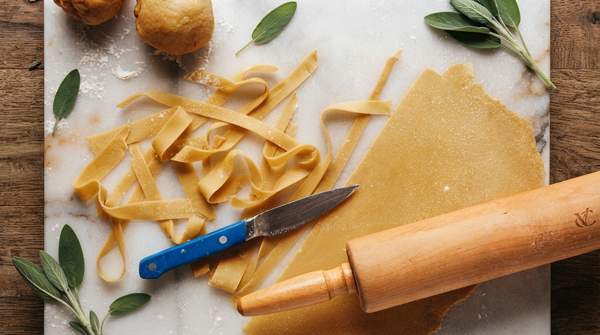
Here is the short answer before we get our hands floury: for delicate, pliable doughs you can roll into sheets, ribbons, or ravioli, reach for finely milled Italian '00' flour in an egg-based dough, hydrated around 61% by weight. For firm, shape-holding doughs destined for extrusion or hand-shaping, reach for durum wheat semolina in a water-based dough, starting around 50% hydration. Those two numbers, and the flour choice behind them, are the levers that turn a crumbly mess or a sticky disaster into dough that behaves exactly as your shape demands.
Understanding the Foundation: Flour Types for Fresh Pasta
The first thing I internalized about pasta is that flour is not interchangeable filler—it is the architecture of the dough. Italian '00' flour is milled to an exceptionally fine texture, so fine that Emilie Raffa, writing at The Clever Carrot, describes its feel as resembling baby powder. That fineness matters: it hydrates evenly and produces a soft, delicate dough that lends itself to tender results.
The miller Caputo, a family firm that has selected and blended wheat for specific culinary applications for more than three generations rather than producing one all-purpose flour, explains that its '00' Pasta Fresca flour is milled to the finest texture possible and formulated specifically to hydrate evenly and create a smooth, elastic dough. In their framing, the fine '00' grind comes from the heart of the wheat kernel, and the flour "lends itself beautifully to fresh pasta, from silky ravioli and filled shapes to ribbons of hand-rolled pappardelle."
Semolina is the other pillar, milled from durum wheat rather than soft wheat. Where '00' is powdery and delicate, semolina is coarser and produces a dough with real backbone—firmer, chewier, and able to hold ridges, grooves, and intricate shapes without collapsing or sticking. This is the flour of southern Italian traditions, the kind you want when a shape has to survive being pressed, dragged, or extruded. One practical note from the evidence: Italian semola is generally finer than American semolina, so the grind on your bag can affect how the dough comes together.
The Science of Hydration: Why Water Matters
Hydration is simply the weight of your liquid expressed as a percentage of the weight of your flour. One hundred grams of flour with fifty grams of water is a 50% hydration dough. Weigh everything—Giulia Prazza at Pastidea makes a point that applies to eggs too: always weigh them, since their sizes vary, and eggs are liquid in your calculation.
Why does the percentage matter so much? Because water determines whether your dough is a stiff, reluctant mass or a soft, yielding one. Raffa notes that most pasta doughs fall between 50% and 60% hydration, and that her own recipe sits at 61%, which "makes it softer and easier to knead by hand. No more crumbly dough!" That is the practical trade-off in a single sentence: more water buys you pliability and easier kneading; less water buys you firmness and shape retention.
But hydration is a starting point, not a law. Prazza cautions that ambient humidity and temperature affect absorption—you may need less liquid on a humid day and slightly more in very dry conditions. Gabriella Simonian, who writes the pasta guides at noregrettispaghetti.co, reports the same from her own kitchen: in a tropical climate, her 50% dough can be "drastically impacted" by the environment, becoming extra moist and overly pliable. Her rule of thumb is telling—if she has to add flour while shaping, her hydration point was off from the start.